Five television series, each with their own crews, spanning seven hundred and twenty six episodes and twelve movies (About six good ones), and countless fan-made stories from 1966 and still going strong, Star Trek can be daunting to get into. It came back into focus in 2009 when JJ Abrams released his reboot movie, Star Trek. The movie helped create a new generation of Trekkies, but the sheer enormity of the Universe and source material makes it difficult to take in exactly what the Star Trek Universe is all about. I will be giving a crash course in the most important parts of Star Trek, starting with the most fundamental aspects and working towards the base details.
The Klingon Empire Insignia
The Klingon Empire
Unlike the Federation, the Klingon Empire, as it is depicted in most Star Trek series, does not have a real-world equivalent. The Klingons are a warrior race who consider honour, loyalty and combat ability to be the most important aspects of life, and their entire culture revolves around those aspects. The Empire was founded by Kahless, who is a messiah-like figure to the Klingon people. He was the first to unify the Klingon homeworld of Qo’nos under one banner. Kahless was the first Emperor of the Klingon people, though that position holds very little power. The Emperor is decided by birthright, either being Kahless or one of his descendants. The true head of the Klingon Empire is the High Chancellor. The High Chancellor was head of the Klingon High Council, a government of twenty four with the Chancellor as its head. The High Chancellor rises to power by defeating the previous Chancellor in honourable combat.
The Legendary Sword of Kahless
The Empire was at odds with the Federation for over a century after a disastrous First Contact between humans and Klingons. The two powers were in a cold war state during the 22nd and the most part of the 23rd century. Towards the end of the 23rd century, Praxis, a Klingon moon and home to their key energy production facility, exploded. This disaster prompted the High Chancellor to seek a peace treaty with the Federation, as the Empire could no longer afford continued hostility between the two people. After signing the Khitomer Accord, a treaty of peace and friendship between the two factions, The Federation and Klingon Empire enjoyed a long, albeit tested, era of peace in the 24th century. This didn’t prevent the Klingon Empire and Federation locking horns in the Klingon/Federation war of 2372, although it lasted less than a year before the Khitomer Accord was renewed.
Federation/Klingon War
As well as butting heads with the Federation, the Empire was at odds with the Romulan Star Empire. Klingons and Romulans were mortal enemies for centuries. The two cultures are polar opposites in a lot of respects; Romulans favour underhanded tactics and guerrilla warfare to the Klingon’s honourable and open approach. It’s not known when the Klingon Empire and Romulan Empire first started hating each other, but there was a time in the mid 23rd century when the Romulans were provided with Klingon D7 battle cruisers. It was in the late 23rd century that Romulans were declared Blood Enemies of the Empire. The two Empires have been at odds with each other ever since.
Klingon ships assist the Federation against the Romulans
The Klingons fought many battles throughout Star Trek Lore, including two wars with the Federation and at least one with the Romulan Star Empire. The Klingons assisted the Federation defence at the Battle of Wolf 359, when the assimilated Jean-Luc Picard, Locutus, was on a mission to assimilate earth. Despite infiltration by changelings in their government, the Klingon Empire was part of the Alliance that fought against the Dominion in the Dominion war of the late 24th century.
Klingon Defence Force
The Klingon Defence Force, or KDF for short, was the military fleet of the Empire. Unlike Starfleet, the KDF was purely dedicated to defence and other military means. The Empire are only interested in exploration that could improve their military might. Military spending by the KDF was part of the economic crisis caused by the destruction of Praxis which, ironically, led to the signing of the Khitomer Accords. The KDF has no official motto, but Klingons have something even better: songs of glorious battle. I leave you with this ballad, “Hear! Sons of Kahless”, sung by the crew of the IKS Rotaran after a glorious victory in the Dominion War.
By Hugh
This article was written for Geek Ireland. Original Publication here:
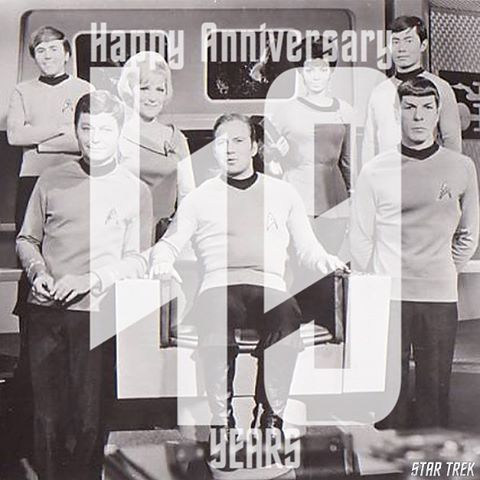
On September 8th 1966 Gene Roddenberry’s Star Trek released it’s first episode “The Man Trap” Starring William Shatner as Captain James T Kirk, Leonard Nemoy as Mr Spock, DeForrest Kellyas Dr. McCoy, George Takei as Sulu and Nichelle Nichols as Uhura.
The Man Trap: “Dr. McCoy discovers his old flame is not what she seems after crew members begin dying from a sudden lack of salt in their bodies.”
This was in fact the second Pilot for the series after “The Cage” was shown to NBC in February of 1965 with Jeffrey Hunter as Captain Pike leading the USS Enterprise. However it was September 8th 1966 that lunched the series to the public.
Key cast members like James Doohan’sScotty only appeared in voice not appearing on screen until the next episode. Walter Koenig‘s neclear wessel loving Chekov didn’t appear until Season 2, Epsidoe 1 “Amok Time”. Brought in to attract a younger audience to the show and give girls a Davy Jones type love interest.
So to say Happy Birthday we leave you with a great little number from Captain Picard
Five television series, each with their own crews, spanning seven hundred and twenty six episodes and twelve movies (About six good ones), and countless fan-made stories from 1966 and still going strong, Star Trek can be daunting to get into. It came back into focus in 2009 when JJ Abrams released his reboot movie, Star Trek. The movie helped create a new generation of Trekkies, but the sheer enormity of the Universe and source material makes it difficult to take in exactly what the Star Trek Universe is all about. I will be giving a crash course in the most important parts of Star Trek, starting with the most fundamental aspects and working towards the base details.
The Federation
At a very basic level, The Federation is the Space United Nations. It is an alliance of planets, sharing personnel and knowledge, with the primary goal to seek out new cultures and map the Galaxy. The Federation has several different aspects to it, including a military presence, though it has always maintained its primary mission is one of peace. There are dozens of species, and hundreds, if not thousands, of planets, in the Federation. Each planet has its own contribution to the group, whether with ships, technology or resources. Those who do not wish to join, or are not yet warp capable, are left alone. this is the most important rule in the entirety of The Federation: the Prime Directive.
The Federation is usually portrayed in a positive light, showing the potential Humanity has for ultimate good in the Future. There are very few, if any, internal struggles among humans, there is no economy as money has been eliminated, and gender equality is certainly all sorted by the 24th century. The Federation is not above forming treaties with other species without assimilating them into the larger group. The Federation has non aggression pacts with the Klingons and the Romulans, a result of wars with both their species, and has even allied with them before, most notably in the war with the Dominion.
Starfleet
Starfleet is the military and exploration division of the Federation. It consists of multiple fleets of Starships deployed throughout Federation controlled, or unexplored areas of Space near the Federation border. The primary mission of all ships in Starfleet is to seek out new life and new civilisations, though all their ships are also equipped to defend themselves. Starfleet was founded in 2161 with the Federation by four races; Humans, Vulcans, Tellarites and Andorians. Its purpose was to provide protection against aggressive species such as the Klingons.
The military might of Starfleet has been tested several times, to a point where, within the space of just six months, they were challenged by the Borg, the Dominion and the Klingons. These battles, and especially the war with The Dominion (Which I will touch on in a later article) led Starfleet to rapidly develop more advanced weaponry and defences for their ships.
Conclusion
The Federation are, simply put, the “Good Guys”. They’re the ones you are supposed to root for and the ones you’re supposed to aspire to be. Even more than that, they are what humanity could be should we find ourselves not to be alone in the Universe. A galactic Governing body which humans have a great hand in running, and are responsible for helping create. I leave you with the famous monologue which lives on in the hearts of Trekkies everywhere.
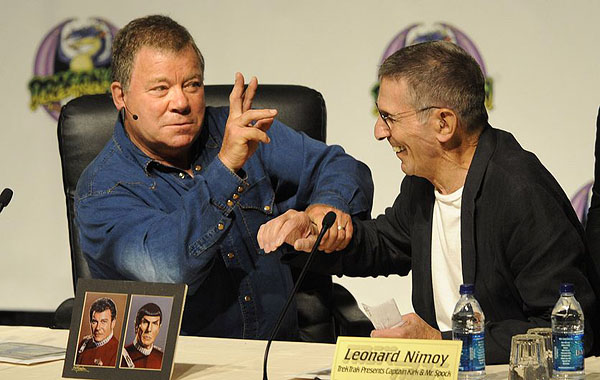
William Shatner has said he’s going to write a biography about his Star Trek co-star and longtime friend, Leonard Nimoy, giving us an inside look at the man and the relationship between the two actors.
According to Showbiz 411, Shatner is already writing the book tentatively titled, Leonard: A 50 Year Friendship which is due for publication in 2016.





 Star Trek Éire